Heritage Imaging Technology
- Research Activities
- Cultural Heritage Conservation Science Center
- 현재 위치Heritage Imaging Technology
Digital Restoration
Recently, diverse digital techniques based on 3D data, along with visual analysis, have been used to restore the estimated prototypes of relics, boosting their aesthetic and academic value, and greatly assisting with the identification of their production techniques. These data are used to review relics before conservation treatment and restoration.
1. Precision 3D Scanning
The target relic's characteristics are identified and a 3D scanner suitable for examining such characteristics is selected before scanning it closely and thoroughly. This process produces an abundance of data, which are used in the work of completing the forms of the relics.
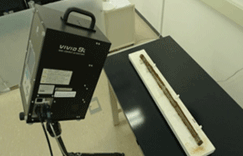
Precision 3D scanning
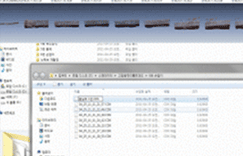
Arrangement of acquired data
2. Completion of 3D Forms
3D image data are combined and matched with each other to make a complete 3D image. An image is completed by dotting three or more identical points in the duplicated section when combining data.
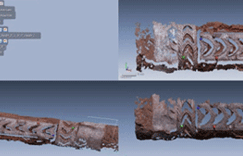
3-point combination
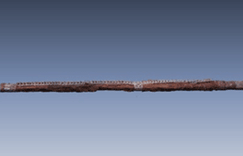
Completion of 3D forms
3. Survey of Data
Before restoring images, using 2D photos and X-ray and CT images, not only the target relic's surface but also its interior should be observed, and various evidential historical data should be surveyed as reference data.
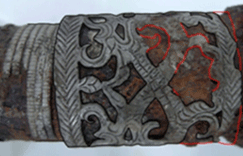
Observation of a connected area and a sketch of a restored form
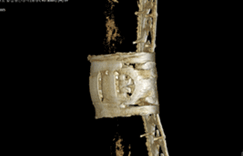
CT images - connection of central members and their characteristics
4. Dismantling by Member
The majority of relics are either damaged and lost or transformed in some way. As such, a part that is close to a prototype should be selected, and the relic should be dismantled by member before modeling each one.
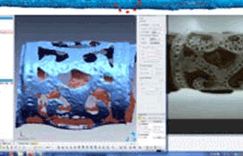
Dismantling by member
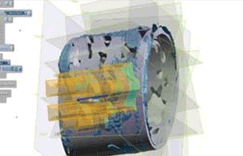
Modeling of open-work decorative design
5. Correction of Transformed Forms
Based on modeled members, the transformed form is corrected.
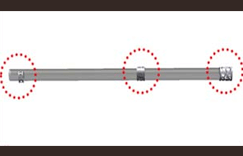
Difference between the corrected body and the existing member’s location
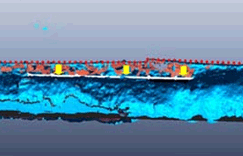
Correction of detached band decoration- Attachment to the body
6. Completion
Compare and examine the scanned data and the restored data and confirm the revised details before conducting the final examination
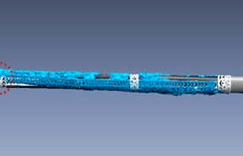
Comparison with original data
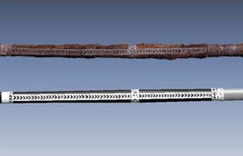
Final completion
7. Videos
- Gilt-bronze Cap from the Andong Ancient Tomb to Goheung
- Memorial Monument of the Cemetery of the Seven Hundred Righteous Warriors
CT
Computer tomography (CT) is an inspection method by which the same x-ray equipment principle is used, radiation is injected from a high-pressure x-ray tube into the target relic, a 3D image isreconstructed, and its internal form, defects, and so on are analyzed.
Non-Destructive Survey of Cultural Heritages Using CT
- Model: SEC X-EYE PCT
- Tube voltage: Max. 225kV
- Tube current: Max. 3mA
- Max. power: 300W
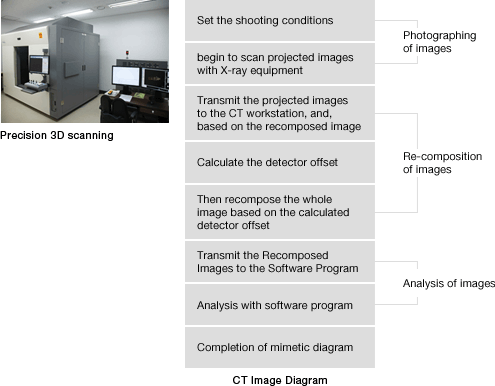
Characteristics of CT
- CT is conducted by shooting, recomposing, and analyzing images in that order.
- Shooting images: While the relic rotates by 360°, certain X-rays continue to be released to scan the images.
- Recomposing images: Transmit the scanned image files to the CT workstation to recompose them.
- Analyzing images: Use the CT-eye3D software and transform the recomposed images into 3D images to analyze information.
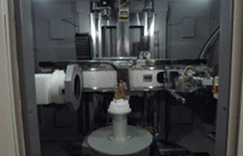
Internal CT structure
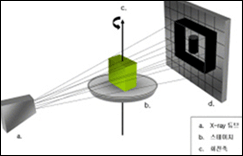
Principle of shooting
Examples of Non-destructive Survey Using CT
Goheung Gilt-bronze Decorative Shoes of Andong

Decorative shoes from the Andong ancient tomb in Goheung (Left: X-ray, center: photo, right: CT image)

Diverse CT images of decorative shoes from the Ancient Andong Tomb
Bamboo tobacco pipe unearthed from Sungnyemun (Bronze)

Diverse CT images of the bamboo tobacco pipe unearthed from Sungnyemun
Fabrics collected from a sarira reliquary bronze bowl, Mireuksa Temple Site (Fabric)

Diverse CT images of fabrics from a bronze bowl, Mireuksa Temple Site
Treasure, Jade Furnace, Hyenchungsa Temple

Multiangle Filimg of the Jade Furnace, Hyeonchungsa Temple
Videos
- Gilt-bronze shoes of Andong in Goheung
- Door lock for Gyeongbokgung Palace